

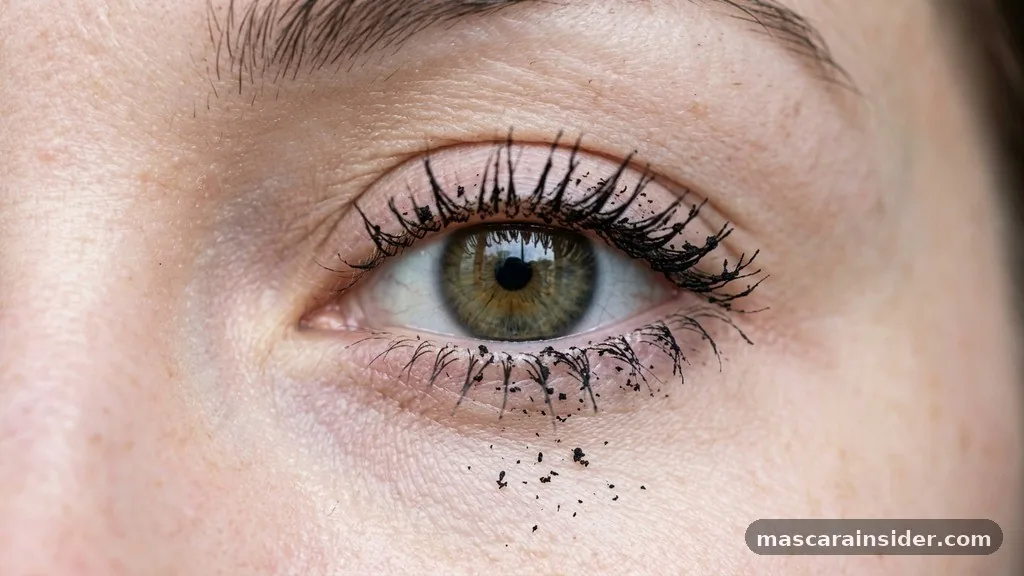
Dealing with the frustration of finding dark, dusty specks under your eyes by midday is a common beauty struggle. If you often wonder why does my mascara flake, you aren’t alone; it is usually a sign that your product isn’t bonding correctly to your lashes or that your eye area environment is working against your makeup.
Whether it’s an issue of product age, skin chemistry, or the wrong formula choice, understanding the mechanics behind these tiny particles is the first step toward a clean, long-lasting look. We will break down exactly what causes this mess and how you can achieve a smudge-proof finish that stays put from morning until night.
The Anatomy of Mascara Flaking
Flaking happens when the polymer technology in your mascara loses its flexibility. Mascara is designed to coat your lashes in a thin, elastic film that moves with your natural blinking.
When that film dries out too much or fails to adhere to the hair shaft, it turns brittle. As you blink throughout the day, the rigid coating cracks, shedding tiny pigment particles onto your cheeks.
Several external and internal factors accelerate this process:
* Dehydration of the formula: Air exposure inside the tube causes the solvent to evaporate.
* Lash texture: Extremely straight or coarse lashes can prevent the formula from gripping evenly.
* Environmental triggers: Low humidity or high heat can dry out the product prematurely.
* Layering issues: Applying too many coats before the first one dries leads to clumping and instability.
Identifying Product Expiration and Quality
A leading reason for product failure is simply reaching the mascara expiration date. Most experts recommend replacing your tube every three months to prevent bacterial growth and ensure the formula remains effective. When a tube nears its end, the preservative system weakens, and the ingredients begin to separate, leading to a dry formula that is prone to crumbling rather than coating.
If you find yourself asking why does my mascara flake despite buying a new tube, check the product’s finish. Some formulas are designed for high-impact volume, which requires a heavier, thicker consistency.
These heavy formulas are naturally more prone to flaking than lighter, lengthening options. Using a lash primer can help create a smooth, tacky base that grips the mascara, preventing it from losing its hold as the day progresses.
The Role of Skin Chemistry and Eye Cream
Your skin type significantly impacts how makeup performs around your eyes. If you use a rich, emollient eye cream, the residual oils can break down the bonds in your mascara. While hydration is essential for your skin, excess product sitting on the lash line acts as a solvent, causing the mascara to soften and eventually flake or smudge.
To mitigate this, try these adjustments:
| Strategy | Impact on Flaking |
|---|---|
| Apply primer/powder | Creates a dry barrier between skin oils and lashes. |
| Wait time | Allowing eye cream to fully absorb for 5-10 minutes. |
| Avoid lids | Apply eye cream only to the orbital bone, not the lash line. |
You can also lightly dust a translucent setting powder under your eyes. This absorbs excess moisture and oil, preventing the environment around your lashes from becoming a “slip-and-slide” for your makeup.
Comparing Formula Types
Not all mascaras are created equal, and some are scientifically engineered to avoid the flaking phenomenon entirely. If you have particularly sensitive eyes or deal with contact lens irritation, your choice of product is even more critical.
Tubing Mascara vs. Traditional Formulas
Tubing mascara is a game-changer for those prone to flakes. Unlike traditional formulas that paint the lash with pigment, tubing versions utilize advanced polymers that wrap around each individual lash like a sleeve.
When dry, these “tubes” do not smudge or crumble. They only release when exposed to warm water, making them remarkably durable.
Waterproof Mascara Limitations
While waterproof mascara is excellent for resisting sweat and tears, it is not always the best choice for flaking. These formulas are often quite drying.
Because they are designed to be hydrophobic, they can become brittle in cold or dry air, leading to the very flakes you are trying to avoid. If you choose a waterproof option, ensure you use an appropriate oil-based makeup remover at night to avoid damaging your lashes during the cleaning process.
Addressing Topical Gaps: Fiber Mascara and Lash Maintenance
A common point of confusion is the use of fiber mascara. These products contain tiny synthetic fibers designed to cling to your natural lashes to add length and volume.
The issue arises when these fibers aren’t properly “sealed” by the wax base of the mascara. If you find your mascara is flaking, it might be because the fibers are detaching from the lash shaft.
To fix this, ensure you are using a “sealing” technique. After applying your fiber mascara, take a clean spoolie brush or a second coat of a standard non-fiber mascara to lock the fibers in place. Furthermore, lash maintenance is vital.
If your lashes are brittle or damaged from frequent curling or harsh removal, they will not hold product as effectively. Incorporating a lash serum can improve the health of your natural lashes, providing a better, smoother surface for your makeup to adhere to.
Refining Your Application Technique
Sometimes the issue isn’t the product, but the application. Pumping the wand in and out of the tube is a common mistake that introduces air into the container, forcing the formula to dry out rapidly. Instead, gently swirl the wand inside the tube to pick up the product.
When applying, start at the very base of your lashes and wiggle the wand upward. This distributes the bulk of the pigment at the root, where it is most stable, rather than at the tips where weight and movement are most likely to cause snapping.
If you notice any clumping as you apply, use a lash comb immediately while the product is still wet. Once it dries, any attempt to comb through will likely result in the flakes you are trying to avoid.
Conclusion
Understanding why does my mascara flake requires looking at both the product you choose and the way you prep your eye area. By switching to tubing formulas, allowing eye creams to dry completely, and avoiding the habit of pumping your wand, you can significantly reduce the amount of product that ends up on your cheeks.
Remember that even the best mascara has a lifespan, and keeping your eye area free of excess oils will go a long way in maintaining a polished, smudge-free look. If you continue to struggle with flaking, try swapping your current formula for one with more flexible polymers, and don’t hesitate to experiment with a lash primer to see if it makes the difference you need.
FAQ
How do I stop mascara from flaking?
Focus on hydration-free eyelids, use a lash primer, and consider switching to a tubing mascara formula.
What is the best mascara for no flaking?
Tubing mascaras are generally the best choice because they form flexible, secure sleeves around each lash.
Does waterproof mascara flake?
Yes, waterproof formulas can become brittle and flake if they dry out or are exposed to cold air.
How do I fix dry flaky mascara?
You cannot safely fix a dry tube; it is best to replace it to avoid eye infections.
Can eye cream cause mascara to flake?
Yes, oils from eye creams can break down mascara bonds, causing the product to crumble and flake.
Why does my mascara flake under my eyes?
It is usually caused by a combination of dry formula, skin oils, or excessive movement of the lashes.
Is it better to use a primer?
Yes, a lash primer creates a smooth, tacky base that helps mascara adhere better to the lashes.


