

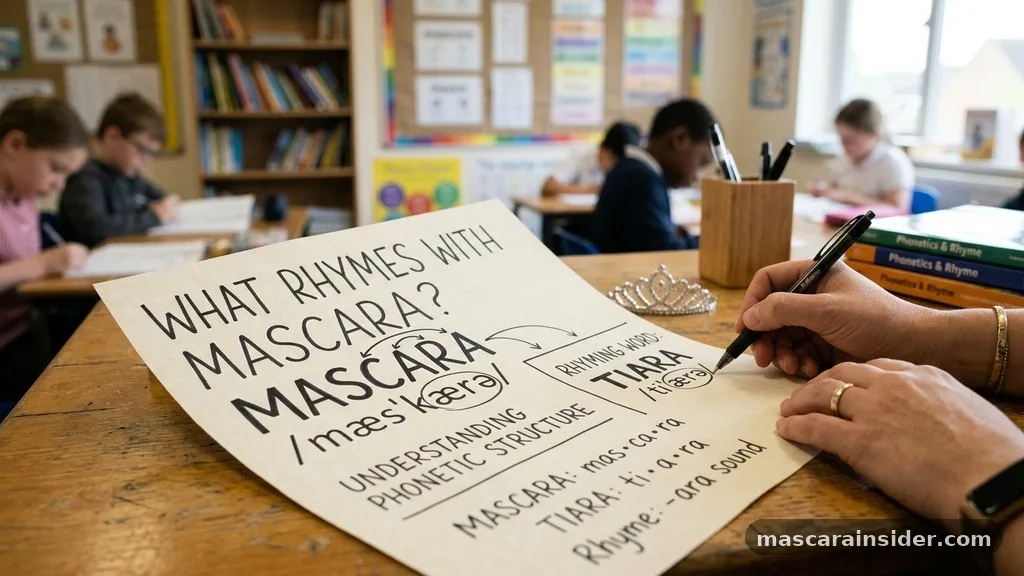
Finding the right word when you are searching for what rhymes with mascara is more than just a simple exercise in wordplay; it is an exploration of phonetics, stress patterns, and the subtle beauty of vowel sounds. Whether you are crafting a poem, writing a song, or simply curious about the structure of language, identifying these matches requires an understanding of how our mouths shape specific sounds. Mascara, a word with its roots in Italian and ultimately Arabic, ends with a soft, open vowel sound that offers a wealth of possibilities for poets and songwriters alike.
This investigation into the linguistic properties of the term will help you understand why certain words fit better than others. By looking at the primary stress on the second syllable, we can categorize potential matches based on their phonetic consistency. You will gain a deeper appreciation for how rhyme functions in English beyond the surface-level matching of letters, looking instead at the underlying soundscape that makes a rhyme feel satisfying to the ear.
Understanding the Phonetic Structure of Mascara
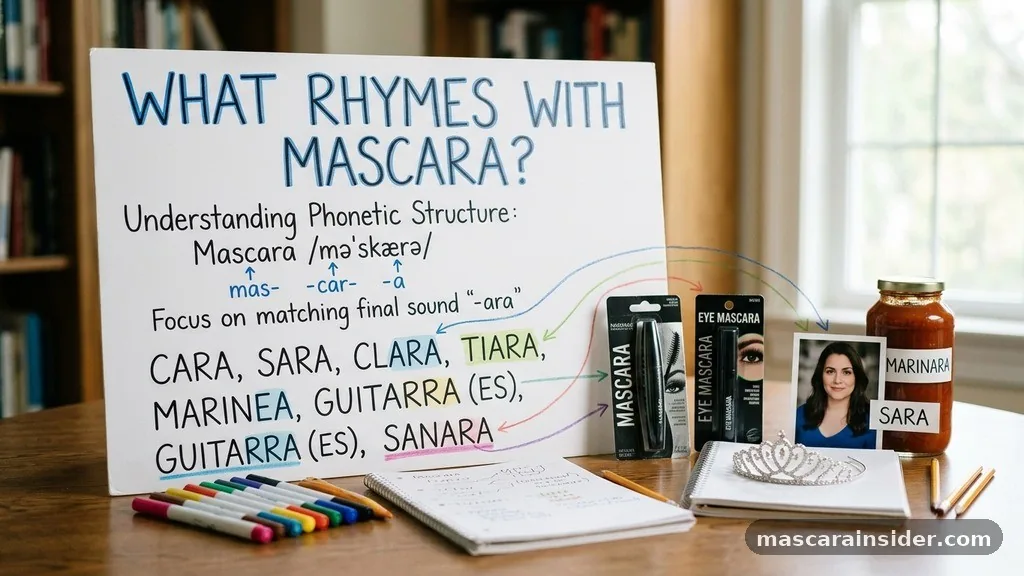
To truly master what rhymes with mascara, one must first look at its phonetic transcription. Mascara is pronounced /məˈskær.ə/ or /məˈskɑːr.ə/, depending on your regional accent.
The core of the rhyme lies in the final syllable, which is often reduced to a schwa sound or a clear vowel, depending on the speaker’s articulation. The primary stress falls on the middle syllable, /skær/ or /skɑːr/, which creates the distinct sound that we need to replicate in a matching word.
When you look for a rhyme, you are looking for words that share this same terminal vowel sound and the preceding consonant cluster if you want a perfect rhyme. Because the word ends in an unstressed vowel, many rhymes are technically feminine rhymes, meaning the rhyme occurs on the penultimate syllable.
This is a common feature in English poetry, providing a soft, flowing conclusion to a line of verse. Recognizing this structure is the first step toward effective lyricism and poetic composition.
Perfect Rhymes for Mascara
A perfect rhyme exists when both the consonant and vowel sounds following the final stressed syllable are identical. In the case of mascara, finding perfect matches can be challenging because of the specific combination of the /ɑːr/ or /ær/ sound followed by the unstressed /ə/ vowel. However, several words align perfectly with this structure, particularly those of similar linguistic origin or those ending in common suffixes.
Words like “tiara,” “Sahara,” and “kara” are among the most common perfect rhymes. These words maintain the same syllable count and the same stress pattern, which makes them feel balanced when used at the end of a line.
- Tiara: A decorative headpiece that shares the same terminal vowel structure.
- Sahara: A geographical term that perfectly mirrors the phonetic ending.
- Kara: A name or term that provides a direct, short, and punchy rhyme.
- Guitara: An archaic or stylized variation that fits the melodic requirement.
- Bawara: A term sometimes used in specific cultural contexts that aligns with the sound.
Using these words in a stanza allows for a sense of closure and structural integrity. When you pair mascara with tiara, for example, the listener immediately recognizes the symmetry, which contributes to the overall prosody of the piece.
Exploring Near Rhyme and Slant Rhyme
Often, a perfect rhyme isn’t available or doesn’t fit the desired tone of your work. This is where slant rhyme, also known as near rhyme, becomes an essential tool.
Slant rhyme occurs when words share similar but not identical vowel sounds or consonant clusters. This provides a more subtle, modern, and sometimes edgier feel to your writing, as it avoids the potentially cliché nature of a perfect rhyme scheme.
When you are looking for slant rhymes for mascara, you can look at words ending in “ar,” “er,” or “or” sounds that don’t necessarily have the exact same vowel quality. Words like “stare,” “care,” “bear,” or “air” might seem like a stretch at first, but they share the /ær/ sound present in the middle of mascara. While they lack the final unstressed syllable, they can be used effectively in free verse or modern song lyrics to create a sonic connection that resonates without being overly literal.
The Role of Syllable Stress in Rhyme
The importance of syllable stress cannot be overstated when analyzing what rhymes with mascara. In English, stress is the relative emphasis given to a syllable in a word. Mascara has a weak-strong-weak pattern.
To make a rhyme work effectively, the matching word should ideally follow the same pattern. If you choose a word with a strong-weak-strong pattern, the rhyme will feel forced or discordant, even if the sounds are technically similar.
Consider the word “camera.” While it shares some phonetic elements, the stress is on the first syllable (/ˈkæm.rə/), which creates a mismatch in rhythm. This is a crucial distinction for poets who focus on meter.
When you are writing, pay close attention to where the natural accent of the word falls. If the word you want to rhyme feels “off,” it is almost always because the rhythm of the sentence is being disrupted by an incorrect stress pattern.
Categorizing Rhymes by Suffix and Origin
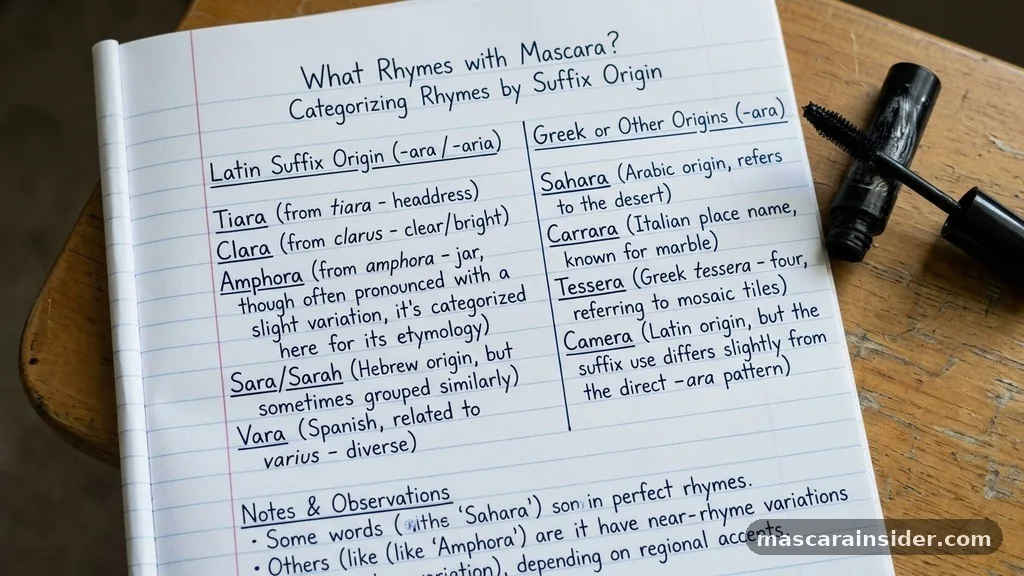
Many words that rhyme with mascara share a common suffix or morphological root. This is particularly true for words borrowed from Latin or Italian, which frequently end in “a.” Understanding these etymological patterns helps you predict what might rhyme before you even look it up in a dictionary.
| Word Category | Example Rhyme | Phonetic Similarity |
|---|---|---|
| Geographical | Sahara | High |
| Jewelry/Accessories | Tiara | High |
| Names | Clara | Moderate |
| Loanwords | Cantara | High |
| Action/Verbs | Prepare a (phrase) | Contextual |
This table demonstrates that nouns, particularly proper nouns and specific objects, provide the best matches. When you are stuck, look toward names and places, as these categories often retain the specific vowel endings that make mascara a unique word to rhyme.
Lyricism and Poetic Meter
In the context of music and poetry, the search for what rhymes with mascara is fundamentally about lyricism. A good rhyme is not just about the sound; it is about how that sound interacts with the surrounding words to create a rhythm.
In a stanza, the rhyme provides a destination for the listener, a moment of resolution. If you place a slant rhyme strategically, you can create a sense of tension that is only resolved by the next line, whereas a perfect rhyme provides immediate satisfaction.
Prosody, the study of the rhythm and intonation of language, tells us that the placement of the rhyme is just as important as the rhyme itself. Placing mascara at the end of a line requires a subsequent line that balances that weight.
If you use a word like “tiara,” the line feels light and elegant. If you choose to use a multi-word phrase like “scare her” as a near rhyme, the tone shifts toward something more narrative and perhaps more dramatic.
Addressing Topical Gaps: Multisyllabic and Phrase Rhymes
A common issue in many resources is the focus only on single-word rhymes. However, in modern rap and complex poetry, multisyllabic rhymes and phrases are often more effective. What rhymes with mascara can also be answered by looking at short, two-word phrases that mimic the syllable count and stress pattern of the original word.
Phrases like “ask her,” “tasker,” and “cask are” can be used as effective rhymes in a rhythmic context. By breaking the word down into its component sounds—/mə/ /skær/ /ə/—you can find matches for each part. “Pass her,” for example, captures the /skær/ sound and the /ə/ ending quite well.
This approach is essential for songwriters who need to fill a specific amount of time in a bar or a specific number of syllables in a line of poetry. Do not limit yourself to dictionary entries; look at the sounds your mouth makes when you speak the word clearly.
Phonetic Transcription and Vowel Manipulation
The vowel sounds in mascara are the key to unlocking its potential for rhyme. The /æ/ sound is an open, forward vowel that is very common in English, while the /ə/ (schwa) is the most common vowel in the language. Because the schwa is so flexible, it is very easy to find words that rhyme with the ending of mascara if you are willing to accept a slight variation in the preceding vowel.
You can also manipulate the vowel sounds slightly through poetic license. In singing, vowels are often stretched or altered to make a rhyme work. This is why you will hear singers rhyme “mascara” with words that are not perfect matches, such as “fairer” or “mirror.”
The key is to match the mouth shape. If you keep your mouth in a similar position for both words, the listener will accept the rhyme, even if it isn’t technically perfect on paper.
The Evolution of Rhyme in Modern Literature
Rhyme has evolved from the rigid schemes of the classical era to the fluid, often experimental structures of modern literature. Today, what rhymes with mascara is less about following a strict rulebook and more about finding the sound that best supports the meaning of your text. Whether you use a perfect rhyme like “tiara” or a complex slant rhyme involving a phrase, the success of your work depends on the context.
As language changes, so too do the ways we rhyme. New loanwords and slang often provide fresh, unexpected matches for traditional words. Staying curious about how language is used in music, social media, and contemporary poetry will keep your writing fresh.
Remember that the best rhyme is the one that serves the story you are trying to tell. Experimentation is not just allowed; it is encouraged. By playing with these sounds and patterns, you can develop a unique voice that transcends the limitations of standard rhyming dictionaries.
FAQ
What are the best words that rhyme with mascara?
The most common and effective perfect rhymes include tiara, Sahara, and the name Kara.
Can you use near rhymes for mascara?
Yes, slant rhymes like stare, air, or phrases like “ask her” are excellent for modern, stylistic writing.
How does syllable stress affect rhyming?
Rhymes are most effective when the stress pattern matches, keeping the rhythm of the line consistent throughout.
Why is “camera” a poor rhyme for mascara?
Although it shares some sounds, the stress falls on the first syllable, creating a rhythmic mismatch.
Are there multisyllabic phrases that rhyme with mascara?
Yes, phrases like “pass her,” “tasker,” and “prepare a” mimic the cadence and sound of the word.
How do I choose between a perfect and slant rhyme?
Use perfect rhymes for formal or simple structures, and slant rhymes for more nuanced, modern, or rhythmic pieces.
Does regional accent change what rhymes with mascara?
Absolutely, as the pronunciation of the middle vowel can shift between a short “a” and an “r-controlled” sound.
As you continue to refine your writing, remember that the pursuit of the perfect match is a journey through the mechanics of sound itself. Exploring what rhymes with mascara reveals the hidden complexity in simple words, allowing you to craft lines that resonate with rhythm and purpose. Whether you are aiming for the elegance of a perfect rhyme or the subtle intrigue of a slant, your choice of words defines the musicality of your work.
Keep experimenting with these phonetic combinations, listen to how different words land in your own speech, and trust your ear to guide you toward the most effective pairings. Your ability to connect these sounds will only grow with practice, so keep writing and let your creative voice lead the way.


